
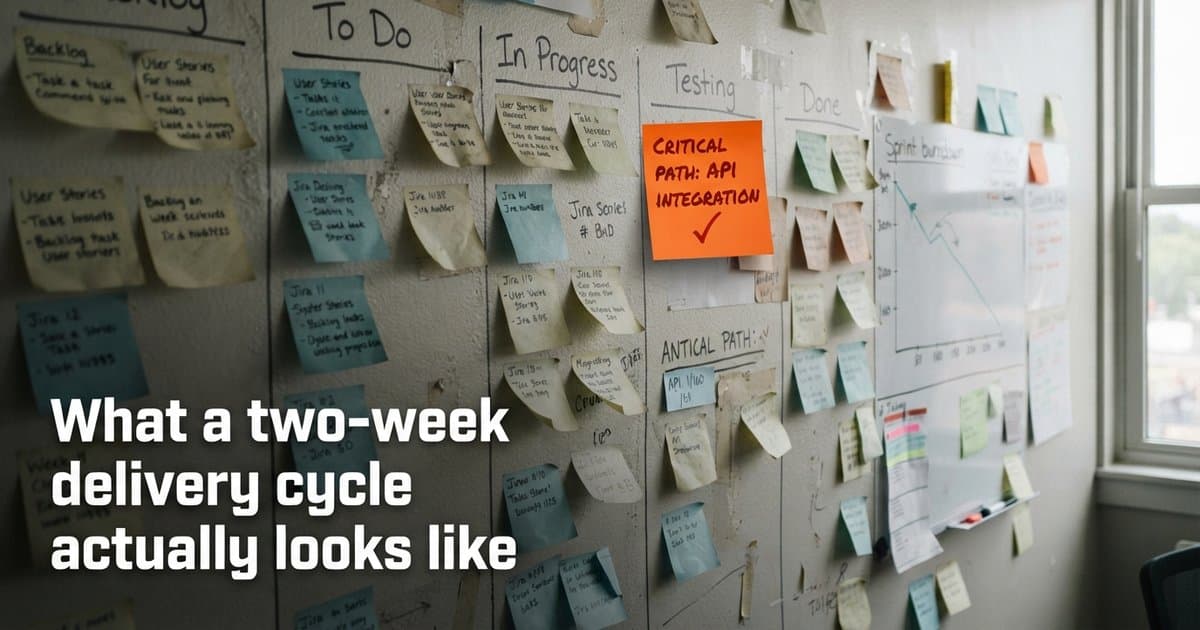
Fortnightly demos are easy to promise and hard to keep. Here is the mechanic that makes them real, and what it asks of the client.
Key Takeaways
- Fortnightly demos are easy to promise and hard to keep.
- Here is the mechanic that makes them real, and what it asks of the client.
Every agency says it delivers iteratively. The test is whether you can click on something at the end of each cycle, on a URL, on your own phone. If the demo is a screen recording or a set of slides, the cycle is a status meeting with a different name.
The mechanic
Work is planned in two-week blocks. At the end of each, whatever is finished is deployed to an environment the client can reach, and the client uses it. Not watches it being used. Uses it.
That constraint does the work. A team that must deploy every two weeks cannot leave integration to the end, because integration is what deployment forces. Problems that would otherwise surface in month four surface in week two, when they are cheap.
It also changes the conversation. "Is the login done?" is a question with a contested answer. "Log in and tell me what you think" is not.
What the client owes
This is the half that vendors describe less often, and it is the half that breaks first.
Feedback has to come back within a couple of days. If it takes three weeks to review a demo, the team either stops and waits or builds on top of unreviewed work, and both are worse than a slower cadence honestly agreed.
Decisions need an owner. On projects where every question routes through a committee, the cycle stretches to fit the slowest approval. Naming one person who can decide is worth more to the timeline than adding a developer.
How scope changes get handled
Requirements change. That is normal and a process that pretends otherwise is a process that produces arguments at the end.
The rule we use: a change is priced before it is built. If it fits in the next cycle, it goes in and something else comes out, and both sides know what was swapped. If it does not fit, it gets a written estimate and a decision.
What this avoids is the pattern where a series of small additions arrive without comment and reappear as a surprise on the final invoice. Nobody enjoys that conversation, and it is entirely preventable by having the small one earlier.
What each cycle produces
A deployed build on a URL. A short written note of what moved, what did not, and why. An updated list of what is next.
The note matters more than it sounds. Six months later, when someone asks why a feature works a particular way, that trail is the answer. It is also what makes a handover to another team possible without a week of meetings.
Where it does not fit
A two-week cycle is overhead on a project that runs three weeks in total. For a small brochure site, a single review and a launch is the honest shape, and imposing ceremony on it wastes the client's money.
It earns its keep from roughly two months upward, and it earns it most on projects where the requirements are genuinely uncertain at the start, which is most software worth building.
Enjoyed this article? Share it with others!
Written by
Antbytelabs
Writing about the software we build at Antbytelabs in Bhaktapur, Nepal.