
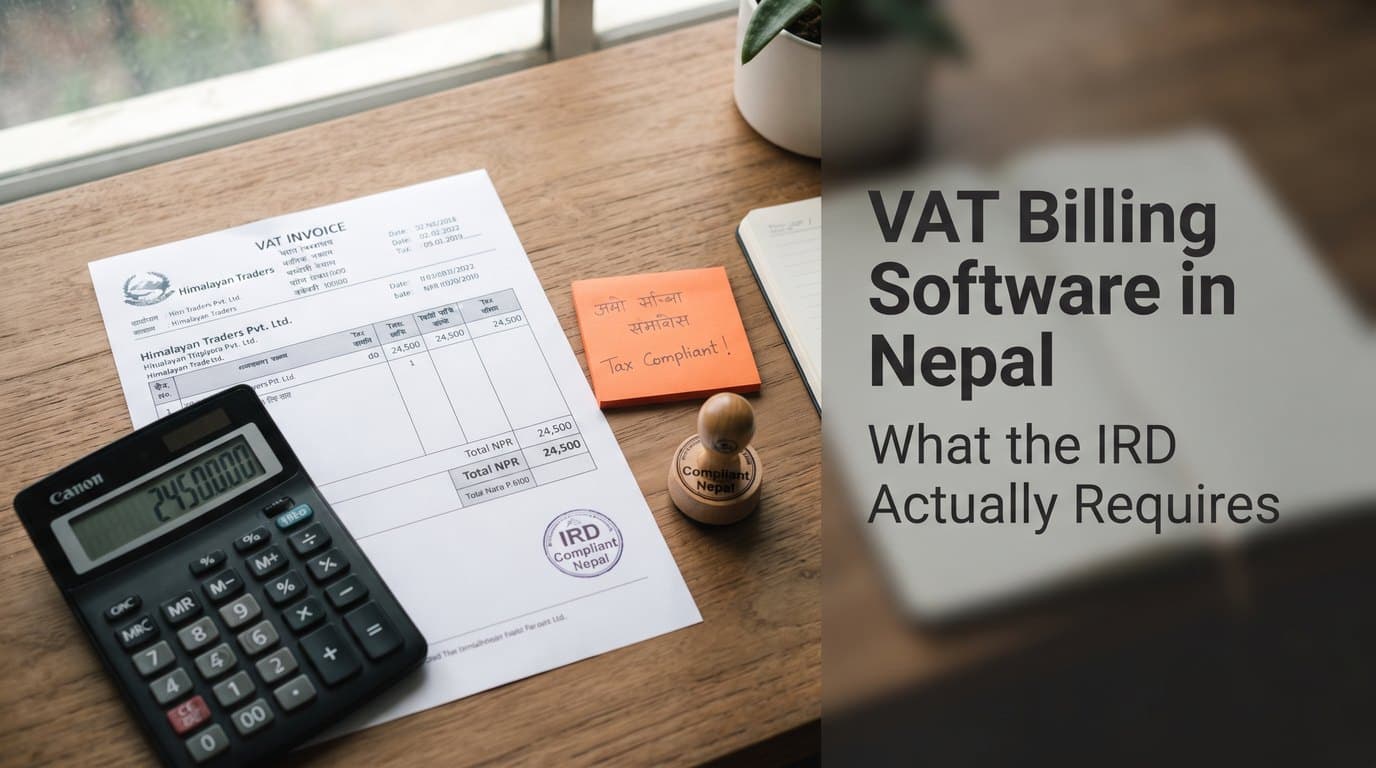
If you are VAT-registered, the software that prints your invoices is not a free choice. What approval and CBMS mean for a custom build, and the four questions to settle first.
Key Takeaways
- If you are VAT-registered, the software that prints your invoices is not a free choice.
- What approval and CBMS mean for a custom build, and the four questions to settle first.
The short answer
If your business is VAT-registered in Nepal, the software that prints your invoices is not a free choice. The Inland Revenue Department maintains a list of approved billing systems, and larger taxpayers are required to transmit invoice data to the IRD's Central Billing Monitoring System rather than just printing a slip and filing it.
Nepal has run VAT at 13 per cent since 1997, and the Inland Revenue Department has moved steadily from accepting printed books to wanting invoice data electronically. That has a consequence most people discover too late: a custom-built system that produces beautiful invoices can still be the wrong system, because the question is not whether it prints, it is whether it is registered and whether it reports.
What usually goes wrong
The software was chosen before anyone asked about VAT
This is the common one. A shop or clinic commissions a system, the team builds order entry, stock and reporting, and invoicing is treated as a printing problem. Then the accountant asks which approved system this is, and the answer is that it is not one.
We see it most with businesses already running Tally or Swastik for accounts who want a custom front end for sales. The front end is the easy part. The question nobody asked was whether the invoice comes out of the new system or the old one, and if both, which of the two owns the number.
Unwinding that is expensive, because the invoice is not a page at the end of the process. It is tied to how you number documents, how you handle returns and credit notes, and what you are allowed to change after the fact.
Nobody decided who owns the numbering
Invoice numbering has to be sequential and gapless, and you must be able to explain any gap. That sounds trivial until two things happen at once: a till crashes mid-sale, or three terminals in a shop issue at the same moment. If numbering is generated optimistically in the application, you will eventually have a gap nobody can account for, which is the kind of thing that turns a routine audit into a long afternoon.
Decide early whether numbering comes from the database under a lock, from the approved billing component, or from a single till. All three can work. Choosing none of them does not.
Edits were allowed where they should not be
A normal application lets a user fix a mistake. A billing system generally must not: once an invoice is issued, the correction is a credit note, not an edit. If the build treats invoices as ordinary records with an update button, you have made it easy to do the one thing the system is supposed to prevent.
Questions to settle before anyone writes code
- Are we VAT-registered, and from what turnover do the stricter requirements apply to us?
- Will we use an already-approved billing system, or do we intend to get ours approved?
- If we integrate with an existing approved system, what is its interface, and does it have one at all?
- What happens to a sale when the connection to the tax system is down? Do we stop selling, or queue and reconcile?
- Who, if anyone, is allowed to void an invoice, and what record does that leave?
On cost: licensing an existing approved system is usually in the tens of thousands of rupees a year, while custom software starts around NPR 300,000 and climbs with scope. If the only thing you need is a compliant invoice, custom is the wrong answer by an order of magnitude. If the invoice is the last step of a process nobody sells off the shelf, it is not.
The fourth question is the one that catches people. A till that cannot sell when the internet drops is unusable in a lot of Nepal, and a till that sells freely and never reconciles is a compliance problem. The answer is almost always a queue with a visible backlog and an alarm when it stops draining, which is the same pattern as any other offline-first design in Nepal.
Where a custom build still makes sense
Plenty of businesses need software around the invoice rather than instead of it. Stock, purchasing, customer records, pricing rules, reporting and whatever makes your business specific are all yours to build, and none of them are constrained by the tax rules.
The usual shape that works is a clean boundary: your system owns everything up to the point of issuing, and the approved billing component owns issuing. You integrate rather than reimplement. That keeps your options open if the rules change, and they do change.
If you are weighing that boundary, our notes on buying versus building and on custom software development cover the trade-off in general terms.
A note on advice
We build software; we are not your tax adviser, and the thresholds and procedures here change. Treat this as a list of the questions to raise, and confirm the specifics with your accountant or directly with the IRD before you commit a design. Any vendor who tells you the compliance details are settled and you need not check is telling you something they cannot know.
Frequently asked questions
Can I use custom-built software for VAT billing in Nepal?
Not freely. Billing software used by VAT-registered businesses is expected to be IRD-approved, and larger taxpayers are additionally required to transmit invoice data to the Central Billing Monitoring System. A custom system can either go through approval or integrate with an approved billing component while handling everything else itself.
What is CBMS?
The Central Billing Monitoring System, the IRD mechanism for receiving invoice data from taxpayers rather than relying only on periodic returns. Whether it applies to you depends on your category, which your accountant can confirm.
What happens if the internet goes down mid-sale?
That has to be a designed behaviour, not an accident. Usually sales continue, the transmissions queue, and someone is alerted if the queue stops draining. The failure mode to avoid is a queue that silently grows for a month.
Can an invoice be edited after it is issued?
Treat it as no. Corrections go through a credit note so the original record and the correction both survive. Building an edit button on issued invoices is the single most common design mistake we see in this area.
How much does compliant billing software cost in Nepal?
Licensing an existing approved system is usually the cheaper route and is what most small businesses should do. Custom work is justified when the business logic around the invoice is genuinely yours. Our price guide covers the general ranges for custom work.
Enjoyed this article? Share it with others!
Written by
Antbytelabs
Writing about the software we build at Antbytelabs in Bhaktapur, Nepal.