
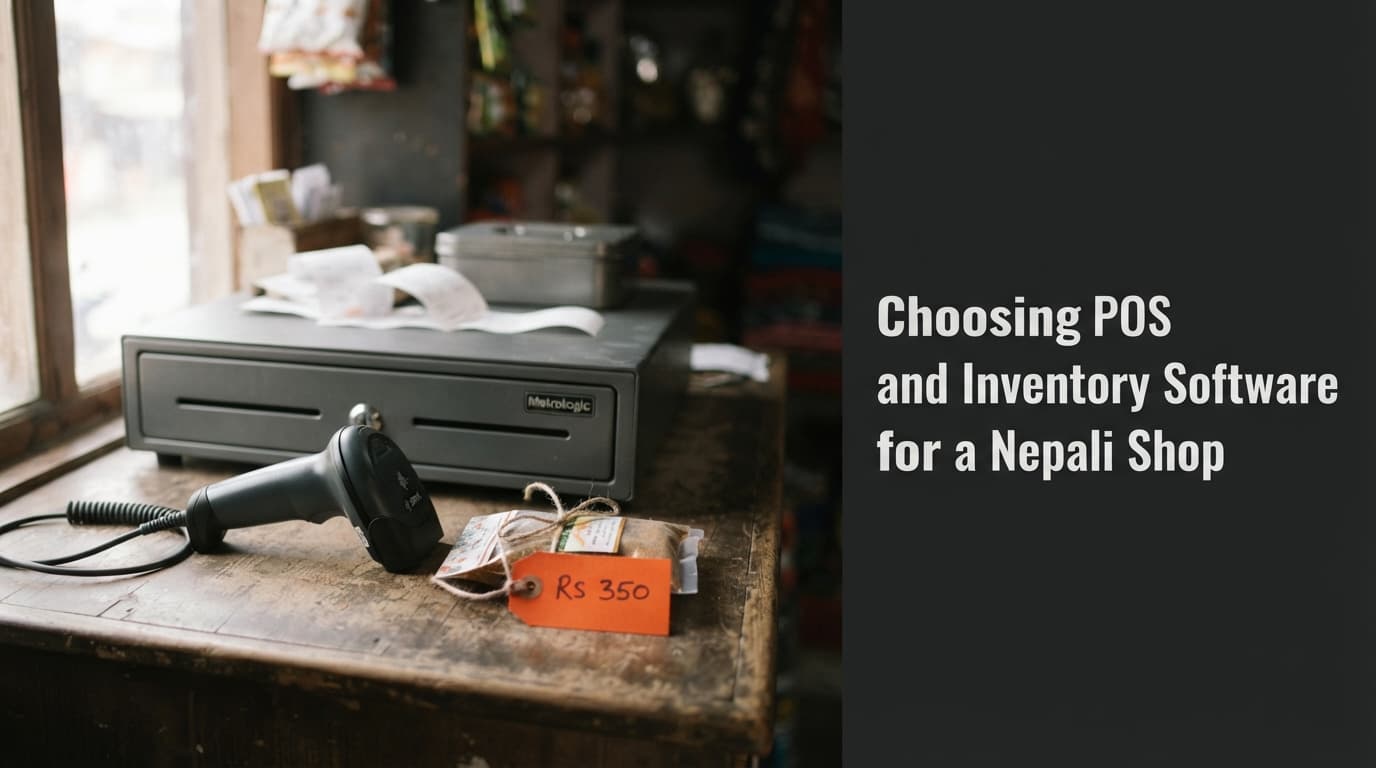
The question that decides everything is what one unit of your stock means. Why most shops should buy rather than build, and what matters specifically in Nepal.
Key Takeaways
- The question that decides everything is what one unit of your stock means.
- Why most shops should buy rather than build, and what matters specifically in Nepal.
The short answer
For most Nepali shops, buy rather than build. POS is a solved problem, the off-the-shelf options are cheap, and a custom till costs more than the margin it protects. Build only when your stock behaves in a way nothing standard handles.
The question that decides it is not "which software", it is "what does one unit of my stock mean". Get that wrong and no amount of software helps.
The question nobody asks early enough
A packet of biscuits is one unit. A metre of cloth is not. A kilo of rice sold loose from a 25 kilo sack is a different thing again, and a pair of spectacles assembled from a frame and two lenses is something else entirely.
Standard POS assumes discrete countable units. If your business sells by weight, by length, in variable packs, or as assembled items made from components, you need to know that before you choose, because it decides whether half the products fit the system at all.
The other half of the question is whether a product is unique. A shop selling five hundred identical phone cases has a quantity problem. A shop selling antiques or custom jewellery has an identity problem, where each item is its own record. Those need different software.
What matters in Nepal specifically
- It has to work when the internet does not. A cloud till that cannot sell during an outage is not a till. Ask what happens offline and how it reconciles afterwards, and test it rather than trusting the answer.
- VAT billing is not optional. If you are VAT-registered, the invoice side has rules. See our note on what the IRD requires from billing software before you commit to anything.
- Devanagari on the receipt. Thermal printers and Nepali text do not always get along. Print a real receipt with real product names during the trial.
- Bikram Sambat dates. If your accountant works in BS and the system only speaks Gregorian, someone converts by hand every month forever.
Stock counts will be wrong
Every inventory system drifts. Items break, get taken, get given away, get miscounted at delivery. The useful question is not how to prevent drift but how quickly you notice and how painful the correction is.
Look for a system where a stock adjustment is a normal, logged, attributable action rather than an edit that quietly rewrites history. If anyone can change a quantity without leaving a trace, your stock report is a guess with a decimal point.
When building is justified
When the stock model genuinely does not fit anything standard, when you run several locations with transfers between them and nothing affordable handles it, or when the till is one small part of a larger operation you are building anyway. Our note on buying versus building covers the general shape of that decision.
Otherwise, buy, and spend the money you saved on getting the opening stock count right. That is the part that actually determines whether the system is useful in month two.
Frequently asked questions
How much does POS software cost in Nepal?
Off-the-shelf options are typically a modest monthly or annual fee, often with hardware bundled. Custom software starts around NPR 300,000 and climbs, which is why it only makes sense when the standard model genuinely does not fit.
Can a POS work without internet?
Good ones do, by queueing locally and syncing when the connection returns. Ask specifically, then unplug the router during the trial and try to complete a sale. The demo always works; the outage is the real test.
Does the POS handle my VAT invoices?
Do not assume it does. Billing for VAT-registered businesses has its own requirements, and a system that prints a neat receipt is not automatically compliant.
What about barcode scanners and thermal printers?
Most standard hardware works. The thing to test is Nepali text on the printer and whether your existing stock has usable barcodes at all. Many Nepali suppliers ship products without them, which means you print your own.
Can it connect to my accounting software?
Sometimes. See connecting your software to Tally or Swastik for what that involves in practice, because the answer is rarely a clean API.
Enjoyed this article? Share it with others!
Written by
Antbytelabs
Writing about the software we build at Antbytelabs in Bhaktapur, Nepal.